Arrau plays Liszt’s Piano Sonata, etc. (Philips Classics)
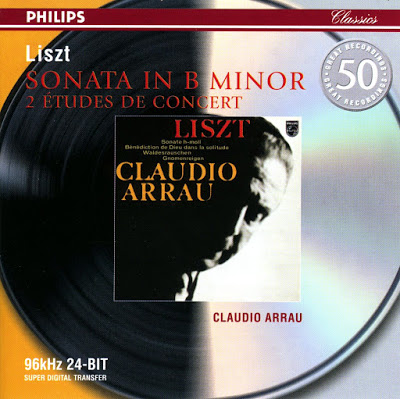
Artist(s): Arrau, Claudio
Composer(s): Liszt, Franz
Series: Philips Classics
My Opinion
Widely regarded as the greatest Chilean pianist of all times, Claudio Arrau was trained with the rigor of the Germanic classical tradition of the early 20th century. His repertoire, while being among the largest of all great pianists, has at the core of its foundations the works of Bach, Beethoven, Brahms, Schumann, Schubert, Chopin, and last but not least Liszt.
Arrau’s affinity with Franz Liszt is easy to comprehend, given that he was trained by a pupil of the great Hungarian composer. The rendition in this disk of one of Liszt’s major works, the monumental piano sonata in B minor, brilliantly showcases this filial relationship. There are ample indications that, as Sir Colin Davis said, Arrau’s “devotion to Liszt is extraordinary. He ennobles that music in a way no one else in the world can.” Here the extraordinary technical command is totally at the service of the artistic expression; and the intellectual, reflective quality of the interpretation is quite simply peerless. The other pieces that accompany the sonata are of the same stellar quality.
This is a recording of Liszt’s great piano sonata that certainly ranks among the top five (or perhaps three) modern recordings available, along with Horowitz, Richter, Brendel, and Argerich celebrated recordings. The Philips remastering is excellent and adds to the appeal of this set.
Reviews
“Claudio Arrau’s 1970 Philips recording of Liszt’s B minor Sonata, not to be confused with his hard-to-find 1985 digital remake, remains unmatched in its fusion of technical finish, personal poetry, and spiritual depth. Under Arrau’s immaculate, amazingly even and supple fingers, the piano’s percussive components are transformed into fluid, organ-like sonorities that resonate from the bottom up. You may cavil with a rubato here or an italicized phrase there, yet there’s nothing remotely self-regarding about this pianist’s trembling theatricality. His bardic style both clarifies and reads between Liszt’s lines without stepping upon or second-guessing them. Once you submit to Arrau’s demanding journey, you’ll be rewarded and nourished for years to come.
The Bénediction de Dieu either can be powerfully sublime or static and trite, depending on the pianist. Arrau’s serious, full-bodied approach pays profound dividends as he sings out the left-hand melody in long arcs against the right hand’s caressing double notes. Likewise, his slower-than-usual Gnomenreignen comes off more like a tone poem than an étude, and Waldesrauschen’s murmuring filigree has gorgeous color and quiet strength (notice the longing with which Arrau inflects its rising chromatic melody).
To fill out the recital, Philips includes Vallée d’Obermann, arguably the high point of Arrau’s great 1969 Philips Liszt recital (when will this be reissued singly?). It’s instructive to hear how Arrau projects the music’s brooding angst and harmonic tension through means of color, touch, and timing, in contrast to the pronounced tempo fluctuations and textural rewrites Vladimir Horowitz imposed on the score. While both approaches are convincing, Arrau’s faith in Liszt’s urtext results in a final peroration that organically flows from what came before, rather than sounding like a tacked-on octave étude. Philips’ 24-bit transfers reveal more tape hiss than previous CD editions and show a brighter if slightly harsher top end. No Liszt lover should be without these transcendent performances. And even if you don’t love Liszt, Arrau’s singular artistry will win you over.” – Jed Distler, review for ClassicsToday.

 Jawad's Classical Music Blog