Furtwängler conducts Wagner’s Tristan und Isolde (Naxos Historical)
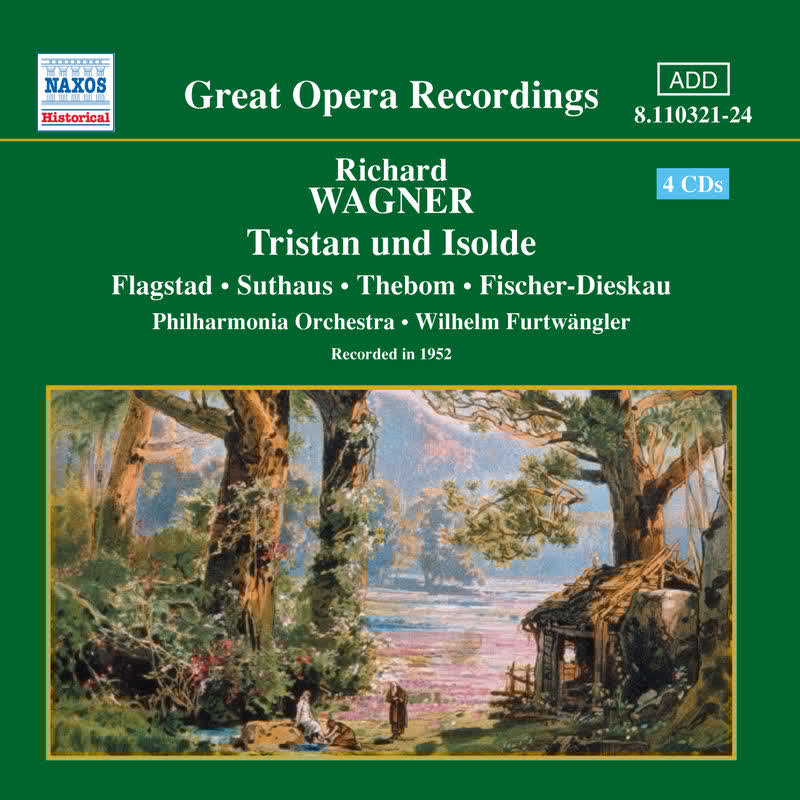
Artist(s): Furtwängler, Wilhelm
Flagstad, Kirsten
Suthaus, Ludwig
Fischer-Dieskau, Dietrich
Thebom, Blanche
Composer(s): Wagner, Richard
Series: Naxos Historical
My Opinion
A friend of mine has reminded me that it is awkward to post more than ten reviews of great recordings, and still miss out somehow on both Richard Wagner and Wilhelm Furtwängler. This is a legitimate grievance I tend to agree with. Allow me, then, to put the matter to rest in style, with one of the most memorable classical recordings of the 20th century.
There is no serious classical music connoisseur that would not rank the great German conductor Wilhelm Furtwängler (1886 – 1954) within a shortlist of the top five conductors of the 20th century. For me, he tops that shortlist, quite simply. I had an embarassment of choices to pick one of his great recordings: one or two of his Beethoven Ninths could have served the purpose, for instance. I have finally settled on this legendary Tristan recorded two years before the master’s death. What made me decide this way are a few elements: an incomparable trio of singers made of Kirsten Flagstad, Ludwig Suthaus, and Dietrich Fischer-Dieskau – putting an ensemble that gets even close to this quality nowadays would be inconceivable, wouldn’t it? the brillance of the Philharmonia Orchestra in its golden age, the 1950s; and last but not least, the genius of Furtwängler’s conducting, bringing a lifetime of experience and artistic pedigree of the highest order to the service of the masterpiece that is Tristan und Isolde.
No four hours of your life could be worthier than the ones you would hopefully spend listening to this recording. Besides, the great sound remastering effort by restoration engineer Mark Obert-Thorn is the cherry on the top of the cake.
Reviews
“Given his eminent position in the world of conducting it is surprising that this 1952 performance was Furtwängler’s first studio recording of a complete opera. Despite his conducting Mozart’s Figaro and Magic Flute at Salzburg in 1950, Walter Legge chose Von Karajan for the studio recordings made that year. Legge also made disparaging remarks about Furtwängler that got back to the conductor’s ears. He consequently refused to allow Legge to be producer of this recording, which was to be the first in London using magnetic tape throughout. Despite having sung her last stage Isolde the previous year, Kirsten Flagstad at 57 was still pre-eminent in the role a position she had occupied since making her debut in the role in 1936. She had been signed up for the recording and insisted on Legge being the producer. The impasse was only resolved by much diplomatic manoeuvring and a convoluted apology from Legge who never produced another of Furtwängler’s recordings.
Norwegian-born Kirsten Flagstad was not merely the pre-eminent Isolde of her day but had been considered the world’s foremost Wagnerian soprano since her debut in a major part at Bayreuth in 1934. Her performance there the previous year in the minor parts of Ortlinde and Third Norn had been her first outside Scandinavia. Happily married to a rich second husband she was seriously considering retirement when the call came to appear at the Wagnerian shrine. Her success at Bayreuth led to a contract at New York’s Metropolitan Opera where she went on to sing Sieglinde followed by Isolde, Brünnhilde, Elisabeth, Elsa and Kundry, all to great acclaim. Flagstad became the rage of New York singing to packed houses and helping the Met back on its financial feet after the disastrous years that followed the Wall Street Crash and great depression. Despite mutual personal antipathy Flagstad appeared regularly at the Met with Lauritz Melchior considered by many to be the greatest ever Wagnerian tenor. A re-recording of Tristan with this duo was made of performances at Covent Garden on May 10th and June 2nd 1936. Its 209 minutes is an abridged version. In poorish sound it can be heard on Naxos 8.110068-70. The two sang together in the March 13th 1940 performance at the Met conducted by Leinsdorf a version of which has appeared on Guild’s Immortal Performances Series. Sub-titled ‘Opera House of our Dreams’, the recording substituted Alexander Kipnis as King Marke from a later broadcast performance. For those not squeamish about such conflations this issue presents Flagstad at the peak of her considerable powers and matched in every respect by the Tristan of Melchior and the Brangäne of Kerstin Thorborg. At 219 minutes it too is a cut performance version. Its sound is not of the quality of this studio recording. Nor does the more superficial conducting of Leinsdorf compare with the passion and intensity Furtwängler draws from the Philharmonia. Allowances for age being made, the sound of the orchestra is well caught and brought out by the restoration engineer Mark Obert-Thorn.
Of the singers only the Brangäne of Blanche Thebom is below par. As the informative booklet essay by Malcolm Walker recounts she was third choice for the recording and at times it shows. Dietrich Fischer-Dieskau is a fine full-toned Kurwenal who shares Tristan’s wounded agony and illusions (CD 4 trs. 1-4). As Tristan Ludwig Suthaus hasn’t the sheer power of Melchior but he is never less than appealing of tone and characterises well throughout. He is appropriately ardent in the love duet (CD 2 trs. 4-7). Of course the success of any performance of this opera depends on the Isolde and there has never been a better interpreter than Flagstad. A not inconsiderable actress her rather matronly appearance had caused comment at her final stage appearances in the role at Covent Garden in 1951. If her singing can be faulted in any way at all it is that she does not convey the sexiness that we might expect in the love duet. This is a small price to pay for the gleaming secure tone, even legato and nobility of phrasing that pervades the rest of her performance. It is a performance to stand alongside any studio opera performance. It is typical of her realism that at 57 she had doubts about her top c in the love duet. Famously Elisabeth Schwarzkopf sang these for her. Those who continue to question Richard Caniell’s conflations on Guild should take note.
EMI re-issued this performance as a GROC, considerably cleaning up the sound. That issue remains in the catalogue and comes complete with libretto and translation at more than twice the cost of this Naxos issue which has an interesting essay, artist profiles and a good track-related synopsis. My only grumble is that 23 tracks for 255 minutes of opera is rather sparse. Otherwise this justifiably famous recording should be investigated by all opera lovers who do not already own a copy.” – Robert J. Farr – Review in musicweb-international.com.

 Jawad's Classical Music Blog