Categories
Uncategorized

Jawad’s Classical Archives – Set 01, CD 008

Klemperer conducts Mozart’s Die Zauberflöte
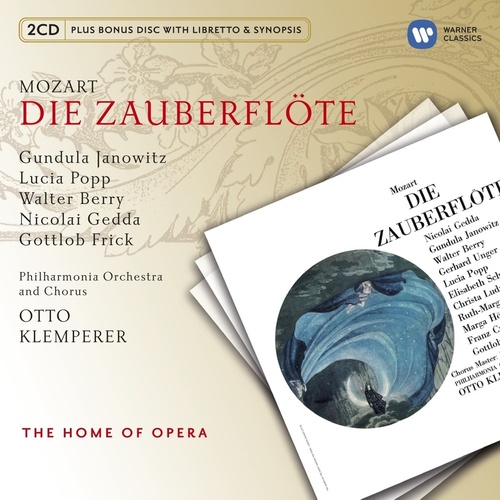
Artist(s): Klemperer, Otto
Gedda, Nicolai
Janowitz, Gundula
Berry, Walter
Popp, Lucia
Frick, Gottlob
Schwarzkopf, Elizabeth
Ludwig, Christa

Composer(s): Mozart, Wolfgang Amadeus

Series: EMI Great Recordings of the Century

My Opinion

I could not delay the presentation of this jewel anymore. Here is one of the greatest recordings of Mozart’s Die Zauberflöte. The work has special meaning to me, being the first complete opera I listened to from first to last note in a single session!

Die Zauberflöte is Mozart’s last completed opera – he completed it about three months before his death – and arguably one of his greatest artistic creations. In many respects, it embodies the culmination of the operatic art of the great Austrian genius. The present recording by the illustrious German conductor Otto Klemperer (who was 79 at the time of the recording!) has never been out of the catalog since 1964. The cast assembled by producer Walter Legge is peerless and would be inconceivable nowadays, as it featured a young Nicolai Gedda playing Tamino, Gundula Janowitz as Pamina, an incomparable trio of Elisabeth Schwarzkopf, Christa Ludwig and Marga Höffgen playing the Three Ladies, an astonishing Sarastro in Gottlob Frick, and finally a glorious Queen of the Night in Lucia Popp. The latter truly stands out, and her marvelous interpretations of ‘O zittre nicht, mein lieber Sohn!’ and ‘Der Hölle Rache….’ never fail to move the hardest hearts. This constellation of artists is beautifully directed by a rejuvenated Klemperer, with a decidedly romantic approach to the score.

In my opinion, only three other modern – post 1950 – performances come close to match the artistry of Klemperer’s account: Herbert von Karajan’s celebrated 1950 recording with the Wiener Philharmoniker, Karl Böhm with the Berliner Philharmoniker, and Ferenc Fricsay 1953 recording with RIAS Symphonie-Orchester Berlin. I promise to present these three recordings in the future. In the meantime, enjoy Master Klemperer and his folks!

Reviews

“Otto Klemperer’s 1964 recording of the Magic Flute has always been a magical performance of a work Klemperer was somewhat in awe of. Like its two predecessors on EMI – Beecham’s 1938 performance with the Berlin Philharmonic and Karajan’s with the Vienna Philharmonic in 1950 – the conception is laid out on the grandest of scales. There is no dialogue and a broadening of tempi where others, particularly period performers, take the work more fluidly. In other words, it is almost anathema to modern day tastes.

Incomplete and old-fashioned it may be, but this performance stands head and shoulders above virtually all others. In part this is due to the singing, which is superlative. Walter Legge had boasted that the cast would be near perfect. In casting Schwarzkopf, Ludwig and Höffgen as the Three Ladies – luxury casting it would be impossible to achieve today – he did indeed create a performance that is vocally unrivalled, underpinned as it is by the unmatched Sarastro of Gottlob Frick and the glorious Queen of the Night of Lucia Popp.

From the very opening of the Overture, with divided violins etching their notes like angels, this is first and foremost a classically poised performance. There is weight of tone, but it is balanced by a natural lightness of touch. Klemperer’s great gift in this opera is his ability to unify the contrasting elements of Mozart’s scoring whether it be in the exalted seria in the Sarastro and Queen of the Night arias, or the pantomime buffoonery of Papageno’s arias. Klemperer, often the most high-minded of conductors, is here a master of the burlesque.

There is so much glorious singing in this recording it is difficult to point out singular highlights for the whole performance is one unending highlight. Lucia Popp’s singing of ‘Der Hölle Rache….’ is an obvious choice the high, murderous tessitura writing holding no fears for a voice which was then young and at its most ecstatic. The Papagena and Papageno duet, near the opera’s close, has Ruth-Margret Pütz and Walter Berry knocking spots off each other with the fleetest woodwind and strings joining in the fun. Gottlob Frick achieves near impossibly low notes in his Isis and Osiris aria.

The Philharmonia (at a difficult time for the orchestra) are sublime to a man, with Gareth Morris’ flute perhaps taking the winner’s prize for most characterful playing. Klemperer himself was surely more vibrant than in any other recording he made in studio post-war.

The stereo recording was always a success, with the balance between voices and orchestra more natural than in some other issues from the time (Giulini’s Verdi Requiem, for example). EMI’s remastering is well focused, if a little dry, and there is some distortion in the choral section that ends the opera. There is, however, more ambience than in previous issues of this recording on CD and at mid-price cannot be missed.

Unlike some of EMI’s recordings in this series this is truly a Great Recording of the Century.” – Marc Bridle.

“As with Karajan and Böhm’s first recorded Magic Flutes, and the pioneering Beecham set, Klemperer’s 1964 EMI version includes the arias and ensembles only, omitting the dialogue. Klemperer’s mesmerizing concentration compensates for the loss in dramatic immediacy. He patiently unravels Mozart’s scoring like a veteran storyteller who relishes every little detail of plot and subplot. The pacing is weighty at times, but never ponderous in the manner of Klemperer’s later Mozart opera recordings.

There’s not a weak link in the cast. The stratospheric reaches of the Queen of the Night’s two arias hold no problems for Lucia Popp, although she is not the natural coloratura Roberta Peters is for Böhm (DG), or Wilma Lipp for both Karajan and Böhm’s mono traversals. Nicolai Gedda brings ardency, tenderness, and intelligence to Tamino, and Walter Berry’s rounded, splendidly articulated Papageno is a joy. Gottlob Frick takes easy charge of Sarastro’s low-lying tessitura (quite impressive for a 58-year-old singer), while the young Gundula Janowitz’s fresh, radiant timbre is just right for Pamina. EMI’s remastering enlivens the bloom and sparkle that characterizes this classic recording. To experience Mozart’s valedictory opera in its true theatrical context, however, Böhm’s Vienna recording for DG (with Solti’s Decca remake as a close second) remains your basic Zauberflöte.” – Jed Distler.
Categories
Uncategorized

Jawad’s Classical Archives – Set 01, CD 007

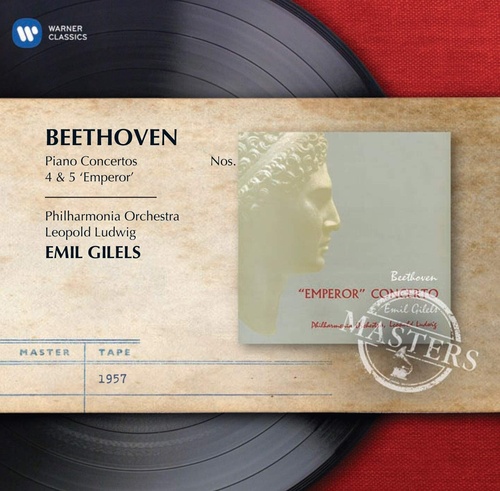
Gilels plays Beethoven’s Piano Concertos Nos. 4 and 5 ‘Emperor’

Artist(s): Gilels, Emils

Composer(s): Beethoven, Ludwig van

Series: EMI Great Recordings of the Century

My Opinion

The great Ukrainian pianist Emil Gilels shines in this legendary recording. Made in 1957, it features Beethoven’s last two – and certainly most popular – piano concertos. When he committed this work to shellac, Gilels was already a living legend in the Soviet Union in the 1950s, and one of a few Soviet artists (along with violinist David Oistrakh, and some years later, fellow pianist Sviatoslav Richter) allowed to travel beyond the steel curtain with the (overtly political) purpose of showcasing USSR’s artistry to western audiences. Expectations were – perhaps unreasonably – high, but the lucky ones who discovered Gilels in his first live performances in London, New York, Vienna, or Paris, were certainly awed by the master pianist’s supreme wizardry.

Although the “Emperor” concerto certainly ranks among the best interpretations of the second half of the 20th century, the real highlight of this CD is the fourth piano concerto. Gilels’ reading is full of power, yet supremely poetic and touching in the slow passages. The second movement, a case in point, has never sounded as magical – and will it ever be? Leopold Ludwig conducts a virtuoso-filled Philharmonia Orchestra and provides elegant and sympathetic accompaniment. The transfer sound is more than adequate for the period.

Allow me to put it plain and simple: there is no better Beethoven fourth piano concerto on record. Period. It would be foolish not to get this CD, listen to it whenever the mood is down, and cherish it for the rest of your – hopefully long and prosperous – life.

Reviews

“Classic accounts of Beethoven here, as Bryce Morrison’s overtly laudatory booklet note makes clear. There are many other Gilels versions of both concertos, but none can boast the resplendent orchestral playing that the Philharmonia delivers nor the excellent – if somewhat beefy – sound provided by Walter Legge and Robert Gooch.

Gilels’ discography lists a number of other Fourths: Leningrad with Sanderling (1957); Czech PO also with Sanderling (1958); live from Naples with Pradella (1965); the famous Cleveland cycle of 1968; USSRSO under Masur (1976) and a live Bavarian performance with Sawallisch (1979). Personally I am most familiar with the Szell Cleveland cycle – with which I was brought up. There is significantly more humanity in these readings of over a decade earlier.

The opening of the present Fourth is very serene and unhurried. Originally issued on Columbia 33CX 1055, this is a magnificent performance. The Fourth is in some ways the trickiest, finger-wise, of the Beethovens. Not that anyone would guess it from Gilels’ finger strength at around 9:20 in the first movement. Only some muddying in the orchestral textures detracts – as I say, the orchestral recording can be a bit obscured at times.

Curiously the orchestra sounds rather dry at the opening of the second movement, something one forgets immediately at Gilels’ hyper-placatory entrance. The end of Orpheus and the Beasts is magical; the finale is full of drive; the strings are nicely together at the opening. If the cadenza is perhaps a touch heavy to begin with, it is small cause for complaint. This is memorable music-making.

There are apparently eleven Gilels ‘Emperors’. Of these I would love to hear the live Chicago with Martinon of 1966. With Ludwig, Gilels seems astonishingly at home, able to unleash the largest fortissimi: the chords around 10’30 in the first movement. His sovereign command is never in doubt here, as he shines from first note to last. Fingerwork is crystal throughout.

Ludwig, excellent in No. 4, if anything excels himself in the ‘Emperor’. The very opening E flat chord is absolutely resplendent, while the opening of the Adagio un poco mosso is unutterably tender, the perfect preparation for Gilels’ magic touch. Nice to hear the accompanying woodwind chords around 3’30, just a pity the oboes are not together at 3’34 – a small point perhaps, but once you’ve heard it you start expecting it on rehearings.

The finale is big-boned, a testament, perhaps, to the barn-storming, revolutionary image of Beethoven, with Gilels’ iron fingers again making Beethoven’s demands seem laughably easy. I should report a pressing error on my copy just before the very end (8’26).

These performances demand to be heard.” – Colin Clarke.

“Although Testament’s 1997 transfers of these 1957 Beethoven recordings markedly improved upon their best-sounding LP incarnations, EMI’s newer Great Recordings of the Century remasterings boast greater amplitude and richness of detail, all to Emil Gilels’ benefit. In several respects I prefer these recordings to Gilels’ remakes with George Szell and the Cleveland Orchestra. The pianist’s spacious conception of the Fourth Concerto cuts Beethoven’s rippling passagework and long trills plenty of poetic slack, and he doesn’t beat the first movement’s left-hand szforzandos over your head as he did under Szell.

Like Gieseking, Gilels’ symmetrical phrase shaping sidesteps the angular accentuation and harmonic tension Leon Fleisher brings out, and he favors Beethoven’s alternate, slightly jarring first-movement cadenza. Still, this remains an impressive performance, and the Philharmonia Orchestra’s first-desk woodwind soloists deserve special mention.

The Emperor Concerto’s outer movements contain a few ensemble lapses and wrong notes, while Gilels presses ahead in passages that would considerably gain from greater inflection and flexibility (the first movement’s B major episode, for instance). But the slow movement is worth this CD’s price. Leopold Ludwig’s basic tempo is unusually slow, yet it’s gorgeously sustained and never drags. Gilels’ hushed entrance is one of the miracles of recorded sound: it appears like an apparition, with every note an exquisite pearl to savor, and not a hint of self-awareness. Pure genius.” – Jed Distler, Review for ClassicsToday.com.

Categories
Uncategorized

Jawad’s Classical Archives – Set 01, CD 006

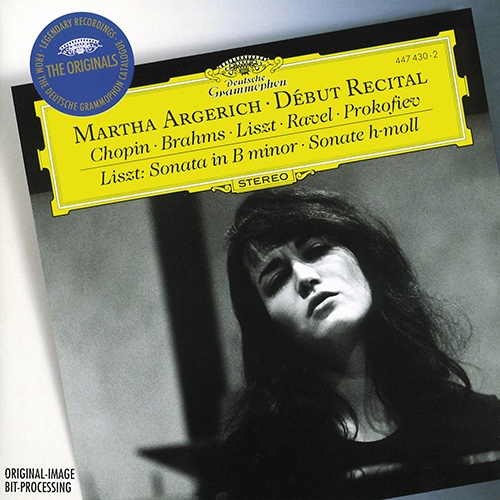
Argerich plays Chopin, Brahms, Prokofiev, Ravel, and Liszt

Artist(s): Argerich, Martha

Composer(s): Chopin, Fryderyk
Brahms, Johannes
Prokofiev, Sergei
Ravel, Maurice
Liszt, Franz

Series: DG The Originals

My Opinion

One may love or hate Martha Argerich’s piano playing, but surely never be indifferent to her artistry and personality. The great Argentine pianist was indeed blessed with a phenomenal technique – result of natural gifts honed by lessons with such distinguished masters as Arturo Benedetti Michelangeli and Friedrich Gulda, yet could be inhibited by long periods of insecurity, self-doubt, and aversion of public exposure.

The present disc, issued in 1961 when Martha was only 20, groups works by Chopin, Ravel, Liszt, Brahms and Prokofiev, with a fascinating account of Liszt’s Piano Sonata in B minor recorded a decade later. While the Brahms’ Rhapsodies may not be totally compatible with her fierce temperament, the other pieces are indeed of the highest artistic order. They definitely issue a strong statement to the musical community that a giant of the keyboard has entered the stage, a genial pianist who will soon take the world by storm in winning Warsaw’s Chopin international piano competition in 1965, a first recognition of a long series to come.

Argerich’s interpretation of Liszt’s piano sonata featured in the disk is indeed a landmark of modern piano playing, and would alone suffice to justify the purchase of the CD at full price. Although the sonata’s recorded discography is huge, in my opinion only three other recordings come close to compete with Martha’s: the historical version made by Vladimir Horowitz in the 1930s (issued by Naxos under its “Naxos Historical” label), Claudio Arrau’s celebrated 1969-70 recording, and Alfred Brendel’s 1981 version.

With no further ado, this is a truly legendary CD filled with great music conveyed by a great artist. There is really no excuse for not enjoying it without moderation.

Reviews

“Here, on this richly filled CD, is a positive cornucopia of musical genius. Martha Argerich’s 1961 disc remains among the most spectacular of all recorded debuts, an impression reinforced by an outsize addition and encore: her 1972 Liszt Sonata. True, there are occasional reminders of her pianism at its most fraught and capricious (Chopin’s Barcarolle) as well as tiny scatterings or inaccuracies, yet her playing always blazes with a unique incandescence and character.

The Brahms Rhapsodies are as glowingly interior as they are fleet (try the B minor’s central molto dolce expressivo). To think that Argerich, fearful of possible failure in such music, begged for last minute reassurance from Nelson Freire, her friend and frequent musical partner.

No more mercurial Chopin Scherzo exists on record and if its savagery becomes flighty and skittish (with the chorale’s decorations sounding like manic bursts of laughter), Argerich’s fine-toned fluency will make other, lesser pianists weep with envy. Ravel’s Jeux d’eau is gloriously indolent and scintillating and the Prokofiev Toccata (a supreme example of his early iconoclasm) is spun off in a manner that understandably provoked Horowitz’s awe and enthusiasm. Liszt’s Sixth Hungarian Rhapsody is a marvel of wit and daring and the B minor Sonata is among the most dazzling ever perpetuated on disc. The recordings have worn remarkably well and the transfers have been expertly done.” – Gramophone Magazine.

“I can’t imagine anyone indifferent to Martha Argerich’s playing. To me, she would inspire either fierce love or fierce hate. I find myself a partisan. This remarkable debut album (except for the Liszt sonata, made when the pianist was 19) has value not only for documenting an auspicious beginning, but in its own right as an exemplar of, at the least, brilliantly imaginative piano technique and musicianship.

I admit I’m a klutzy piano player, at best a duffer, so I have really little idea of technique. However, I do know the difficulty of clear projection, clean textures, and color variation – in short, all the things missing from my playing. With Argerich, each note is both distinct and part of a longer line – each glistens like dew on a spider web.

The program opens with a bang – Chopin’s third scherzo – and one immediately meets a singular sensibility with the fingers to express itself. For me, there are two kinds of Chopin players: Apollonian and Dionysian – those who aim at some ideal, unchanging interpretation and those who, like jazz players, allow themselves to ride the musical wave, to discover things while they play. Both players run risks. The Platonists can fall into stultification. The Bacchantes can become merely eccentric or the performance can simply break apart into chaos. The Platonist’s reward is a kind of “naturalness.” Perfect beauty seems to come from “just playing.” The Dionysian’s reward is ecstatic discovery. It forces the listener to “hear anew.” Argerich clearly belongs to the second group. That at so young an age she could bring off something so individual and so right amazes me. No wonder the Poles went nuts.

Nothing in the interpretation betrays the music. Still, the interpretation remains one-of-a-kind. Argerich chooses to emphasize the instability of the piece. The opening measures harmonically and rhythmically leave the listener up in the air. The confusion lasts only a moment, as she launches into the main strain. This unleashes a demonic energy, which runs smack into a chorale idea. This usually signals pianists to switch straight into their “nobilmente” gear. Yet, Argerich doesn’t take it straight, preferring to contrast the chords with a glittering arpeggio. Again, this destabilizes the texture, leading to (after the reappearance of the chorale idea) an inexorable rush to the end. What Argerich has done, in contrast to other pianists, is essentially extend the arch of the piece. Her command of dynamics and color here is superb.

On the other hand, the Brahms rhapsodies reveal her limitations. Not that anything is downright awful, but the Chopin has led you to expect the extraordinary. For Brahms, in the words of the old Mae West song, “I like a man what takes his time.” Argerich rushes here, and furthermore her tone lacks weight. The left hand, particularly the low bass, is just too light (a fault, by the way, that also besets her Liszt Hungarian Rhapsody). I wanted every section slower, savored, lingered over, including the slow sections. Often it’s just a hair’s breadth of difference. For me, the second rhapsody fares better than the first, with a nice mysterioso in the second rhapsody’s cortege-like lyric subject. However, by the time of her recording of the Liszt piano sonata eleven years later, she seems to have worked through both problems.

The Prokofieff and the Ravel resemble each other, in that their composers designed them to make your jaw drOp. Both rely on a constant undercurrent of smaller note values, which lead some players to emphasize a “sewing-machine” rhythm. Argerich, however, always seeks out the larger phrase, and, in the Prokofieff especially, this isn’t easy. The Prokofieff not only percolates, but curiously it shows the heft missing in the Brahms. Again, each note has its own identity and yet belongs to a constantly moving musical line. In both works, one hears a mastery of shifting color, almost orchestral in its resource. One not only hears water in the Ravel, but different kinds of water, from spray to deep current.

Again, the Hungarian Rhapsody disappointed me a bit – rushed and too light. Despite the flash, Argerich makes nothing of the musical inventiveness in the piece, particularly the unusual harmonic cadential figure in the fast “repeated-note” sections of the piece – VIb,V,I in the bass. I favor Ivan Moravec and Leslie Howard here.

Nevertheless, I find her account of the Liszt sonata stunning at all levels. Obviously, her hands have mastered the notes. However, her ability to find the music in all the notes amazes me. I should say that I’ve never particularly liked the Liszt sonata, or any 19th-century sonata after Schubert. The Liszt in particular has always seemed to me a compendium of cliches and over-reliance on diminished triads and sequence. I’ve heard Horowitz’s EMI recording, Brendel, and Arau. I’ve not heard my two all-time favorite Lisztians, Cziffra and Howard, in this particular work and, in fact, don’t know whether recorded performances exist. Schwann is silent.

The Liszt bears as much resemblance to classical sonata form as a platypus does to a duck. The trick for the pianist is to overcome the obviously sectional nature of the work and make the listener forget that each section is more than a rush to another climax – a tall order, since that’s practically Liszt’s entire rhetorical strategy. Under hands only vaguely connected to the brain, the piece comes off as a garage sale of spare parts. Argerich shows you how Liszt builds an impressive structure from two or three little bits, not even full-fledged themes, and how the composer’s incredible sonic imagination (allied, I’m sure, to his miraculous technique) inventively transforms these bits into new themes, rhythms, and textures. One reads about this in essays on the subject, but Argerich is the first to show this in action. I never realized to what extent the opening downward run in the bass generated the thematic transformations before. It leads to an all-important “repeated note” gesture (4 repeated notes, a little downward fillip, and an upward leap, followed by a chromatic descent of 2 notes), which in turn leads to an important lyrical idea, varied just enough in rhythm and tempo to disguise its parentage. At other points, Liszt breaks up the idea among widely disparate registers. “Repeated note” even gets a fugal treatment. Stuff like this happens throughout the sonata. To Argerich’s immense credit, she never loses the thread or the listener.

However, not everyone listens for this kind of thing, and if the performance consisted of only this, a computer-generated account would suffice. Argerich brings even more, leaving aside the sheer physical excitement of her playing. Listening to the disc a number of times, I’ve discovered that she routinely builds incredibly long spans of music. She not only knows how to shade a phrase through sensitive, momentary builds and releases, she carries this method over longer spans. She knows precisely not only where the high point of a phrase or a section lies, but of an entire piece, even one this long. Other great pianists do this as well. In fact, this for me practically defines a great pianist. The buildup of volume comes more easily than the release, because it’s a primary device of increasing tension and excitement, just as getting faster is. Unfortunately, a player might reach his peak before the music. This occasionally happened to Bernstein, particularly in Richard Strauss. He needed to get louder, but had already shot his dynamic wad, so to speak. The release is much harder: a player often just loses focus and the piece momentarily dies. Argerich always has someplace to go, up or down, and reaching the valley is just as urgent as attaining the summit. The rapid octaves leading to the long, “dying fall” of the coda demonstrate this clearly.

Magnificent.” – Steve Schwartz, Review for Classical.net.

Categories
Uncategorized

Jawad’s Classical Archives – Set 01, CD 005

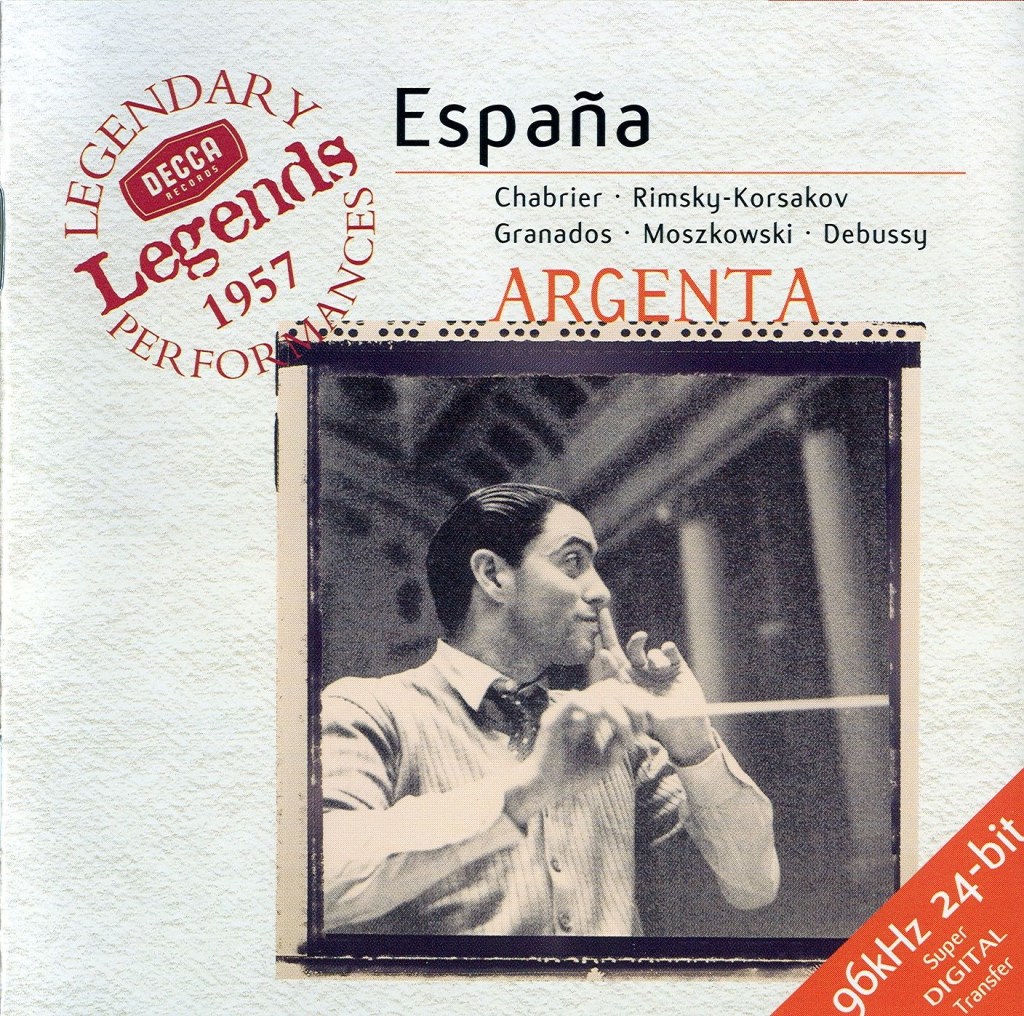
Argenta conducts Rimsky-Korsakov, Chabrier, Granados, etc.

Artist(s): Argenta, Ataúlfo

Composer(s): Chabrier, Emmanuel
Rimsky-Korsakov, Nicolai
Debussy, Claude
Granados, Enrique
Moszkowski, Moritz

Series: Decca Legends

My Opinion

Every once in a while, mankind is robbed of a musical genius by an unfortunate tragic event. This was the case of the Spanish conductor Ataúlfo Argenta, who sadly succumbed to carbon monoxide asphyxia in his own car. He was only 45 years old, and one can only nostalgically dream of the riches of music the world has missed. There is little doubt in my mind that he could have achieved the notoriety of a Karajan, a Klemperer, or a Mitropoulos.

This outstanding Decca issue assembles recordings made with an outstanding London Symphony Orchestra (LSO). For me the highlight of the disk is the excellent Rimsky-Korsakov’s Capriccio Espagnol, where the LSO showcases its virtuosity and the conductor its great ability to keep things under close control. Chabier’s España is of the highest order as well, and the Debussy and Moszkowski do not disappoint either. Listening to Argenta and the LPO perform these Spain-inspired works will, almost magically, produce the distinctive feeling of enjoying a gazpacho in Andalusia, but with a sense of refinement reminiscent of a Viennese evening. In addition, the Decca sound of the disk is excellent throughout. ¡Hombre!  ¡que maravilla!

Reviews

“Ataúlfo Argenta was a very talented conductor whose career was tragically cut short as a result of carbon monoxide poisoning–he was discovered in his garage with his car engine running. His recordings always have been prized by collectors, and include a fine Berlioz Symphonie fantastique, as well as this disc, a collection that combines the contents of two LPs. Debussy’s Images receives a thoroughly idiomatic reading, which is only to be expected from the same orchestra that Ernest Ansermet had trained and with which he recorded this very music a couple of years previously. But Argenta’s ability really stands out in the couplings, in which he coaxes some fine playing from a London Symphony Orchestra that was, in 1957, in the midst of its most slovenly period. His Rimsky-Korsakov Capriccio espagnol might not have quite the pizzazz of Bernstein’s, but it’s elegant and exciting by turns, and his Chabrier ranks with the best. Although already reissued in Decca’s “Classic Sound” series, this re-remastering at least means that the disc will remain available for a while longer. Buy it while you can.” – David Hurwitz.

Categories
Uncategorized

Jawad’s Classical Archives – Set 01, CD 004

Lipatti plays Chopin’s 14 Waltzes, Barcarolle, etc.

Artist(s): Lipatti, Dinu

Composer(s): Chopin, Fryderyk

Series: EMI Great Recordings of the Century

My Opinion

The tragic death of the great Romanian pianist Dinu Lipatti at the astonishingly young age of 33 robbed the world of a supremely gifted artist. About him, Harold Schonberg, the famous music critic, wrote in 1953: “Lipatti, a master of the keyboard, would have developed into one of the supreme artists of this era. He was a pianist of the Rachmaninoff order, blessed with an enormous technique and a strong rhythmic sense”. There is hardly any exaggeration in this overly laudatory opinion, and that speaks volumes of the high esteem in which Lipatti was – and still is – held in the classical music community.

The present recording of Chopin’s waltzes and other pieces was made between 1947 and 1950. The artistic quality of these pieces is in my opinion unequaled – and I have listened to many other great Chopin interpretations, from earlier accounts by Alfred Cortot and Artur Rubinstein, to more modern contributions by Murray Perahia and Vladimir Ashkenazy. What makes Lipatti’s account of the waltzes even more special is the fact that they were performed at a time when he was struggling with the leukemia that will eventually claim his life. And what can I possibly say about the glowing Barcarolle, the wonderful Nocturne, or the atmospheric Mazurka? In summary, I do not think there are not enough stars to rate this recording. Please do yourself a favor: just grab this disk and rush to your CD player. You won’t be disappointed.

Reviews

“Still regarded by many as the greatest set of Chopin waltzes ever recorded, Dinu Lipatti’s performances continue to astonish. He strokes the keyboard with such delicacy, finesse, and, where required, unobtrusive strength that the music simply seems to play itself. All of Chopin’s music is, of course, exceptionally well written for the keyboard, but the sense of rhythmic lift, the inevitability–these are the hallmarks of a great artist. It’s terrible to think that when he made this stunning recording, Lipatti was already in pain and dying of leukemia; there’s certainly no hint of it in his playing. EMI’s transfer has been accomplished with considerable skill, and we can only be grateful that Lipatti was with us long enough to finish this affecting tribute to all that’s most beautiful in life.” – David Hurwitz.

“By general acclamation, this is the finest recording of the Chopin Waltzes ever made. The Barcarolle has garnered similar plaudits. Dinu Lipatti had a brief, incandescent career cut short by disease. He brought to Chopin a searching intellect allied with an infallible sense of rhythm and a technique utterly at the service of his musical ideals.
One could continue to throw adjectives at Lipatti’s playing without ever capturing the feeling of “rightness” that permeates it. His audiences were moved by something they felt as spiritual. Perhaps the ultimate compliment would be that he makes Chopin live again–we see the composer exalted through the transparent medium of Lipatti’s re-creation.
The vintage 1950 mono sound is quite good. The producer for these sessions was the immortal Walter Legge, whose own high opinion of Lipatti is summed up thus, “God lent the world His chosen instrument, whom we called Dinu Lipatti, for too brief a space.” – ArkivMusic.com

“As an erstwhile pupil of Cortot, it was perhaps not surprising that Lipatti always kept a special place in his heart for Chopin. This selection was first reissued on CD two and a half years ago. And thanks, primarily, to the 14 Waltzes, played in a non-chronological sequence of his own choosing, I doubt if the disc will ever find itself long absent from the catalogue. Like the solitary Mazurka, they were recorded in Geneva during his remarkable renewal of strength in the summer of 1950. The Nocturne and Barcarolle date back to visits to EMI’s Abbey Road studio in 1947 and 1948 respectively.
Just once or twice in the Waltzes I questioned his sharp tempo changes for mood contrast within one and the same piece—as for instance in No. 9 in A flat, Op. 69 No. 1. But for the most part his mercurial lightness, fleetness and charm are pure delight. The Nocturne in D flat has long been hailed as one of the finest available in its passage ”from intimacy to drama, from tenderness to reverie”, as his biographers Tanasescu and Bargauanu once put it. And even though we know he himself (one of the greatest perfectionists ever) was not completely happy about the Barcarolle, for the rest of us this glowing performance has a strength of direction and shapeliness all its own. In fuller contexts there is just a trace of plumminess in the recorded sound. But no one need worry about that in the face of such artistry.” – Gramophone Magazine.

Categories
Uncategorized

Jawad’s Classical Archives – Set 01, CD 003

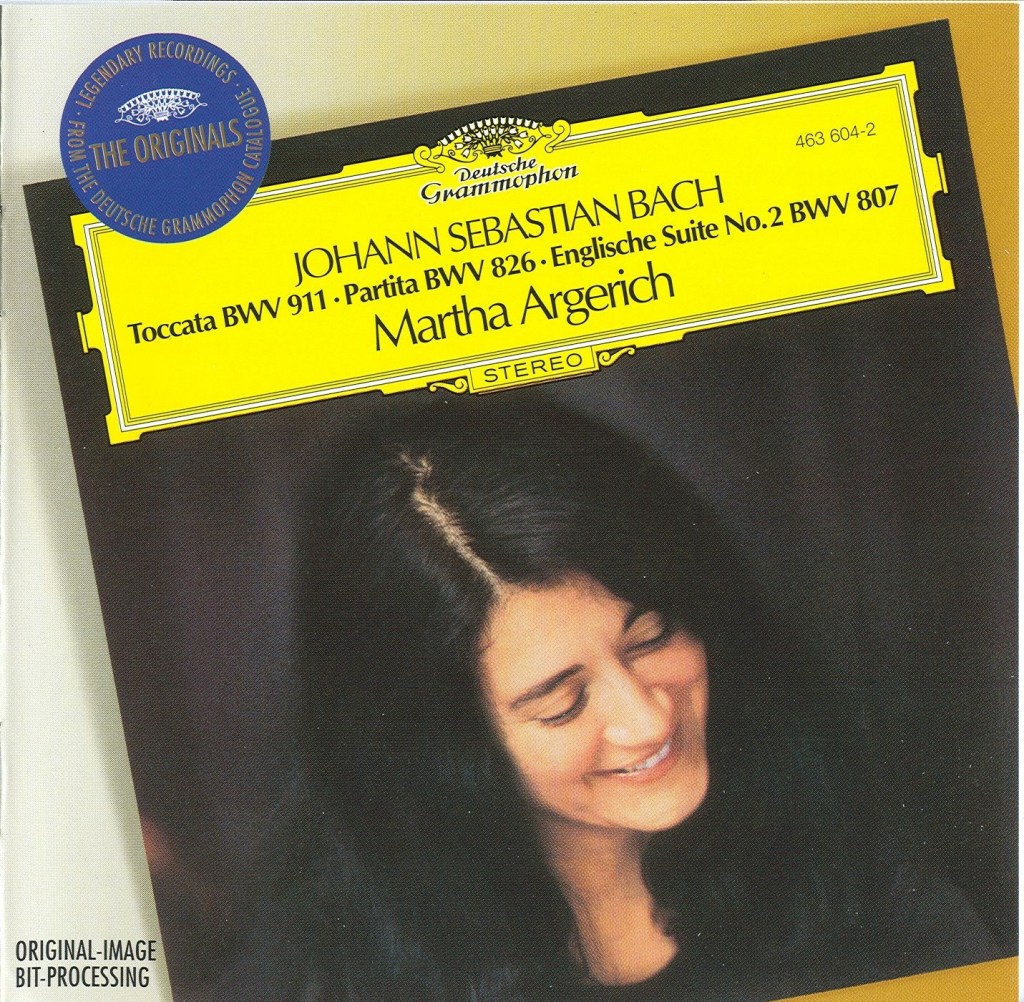
Argerich plays Bach’s Toccata, Partita, and English Suite No. 2

Artist(s): Argerich, Martha

Composer(s): Bach, Johann Sebastian

Series: DG The Originals

My Opinion

This is perhaps an unorthodox and unusual pick for introducing the great Argentine pianist Martha Argerich – a more straightforward selection would probably have involved her incandescent Chopin, Liszt, or Ravel instead, or maybe her mind-blowing Rachmaninoff and Prokofiev piano concertos. This is precisely the problem with Martha: virtually all her output is of legendary status, and we often have an embarrassment of riches with her. But this is not really a problem, is it?

This 1980 DG issue showcases the lioness of the keyboard’s supreme technical control in face of the special demands of Bach’s piano music playing. Her approach somehow manages to achieve Glenn Gould’s clarity of articulation without the Canadian master’s famous eccentricities. The sound quality is excellent, and with the right equipment, listening to this CD is quite an experience. Wonderful!

Reviews

“There is a lot to be said for a respected brand name. The feeling of confidence it gives the purchaser otherwise uncertain whether or not to hand over his hard-earned money and, of course, the return to the business that has built up the name over a long period. These thoughts are prompted by the Martha Argerich CD for review, which is on the DGG Originals label with its familiar yellow cartouche and the mock vinyl appearance to the disc inside. You know where you are with this series even though its remit is now wider than when the selection first began. This confidence is more than justified in this latest offering from DG.
Martha Argerich is best known as a marvellous exponent of Chopin and the late Romantics. Her recordings and performances of Bach have been limited and this release – her only solo Bach recording – is one that has been around the listings now for many years and it deserves to reach a fresh potential audience. The immediate point that strikes one is the utter clarity of the fingering – nowhere is there a trace of fudge – and her rhythmic drive that involves the listener and sweeps him along. At times I thought I was listening to Glenn Gould without the sing-along part.
Her approach is unmannered, lean – almost austere – and quite beguiling. Her playing is masterly and the definition of the contrapuntal lines is always clear. I know there is a view that Bach should not be heard on a piano if a harpsichord is available but people who have that view should try this disc. Just a sample of – for instance – the Rondeau in the Partita, or the opening Prelude of the English Suite should convince the undecided.
The recording is excellent – a considerable improvement on the original LP as I recall it – and even at 50 minutes can be recommended with confidence.” – Harry Downey.

Categories
Uncategorized

Jawad’s Classical Archives – Set 01, CD 002

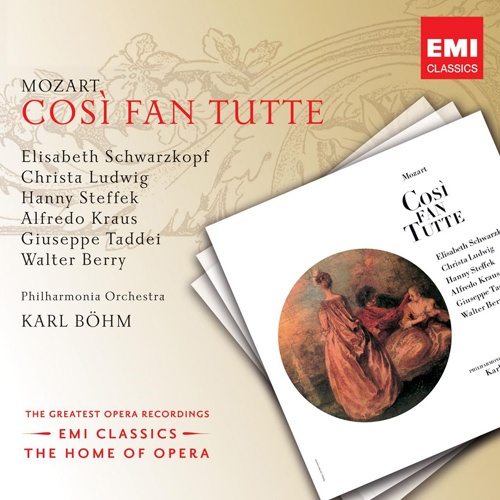
Böhm conducts Mozart’s Così Fan Tutte

Artist(s): Böhm, Karl
Schwarzkopf, Elisabeth
Ludwig, Christa
Kraus, Alfredo
Taddei, Giuseppe
Berry, Walter

Composer(s): Mozart, Wolfgang Amadeus

Series: EMI Great Recordings of the Century

My Opinion

Mozart finished the composition of Così Fan Tutte in 1780. The work is not the composer’s most well-known opera to the general public, but still has its unique charm and distinctive cachet. Modern musicologists are adamant that Così is the work of a composer at the pinnacle of his considerable creative powers. Suffice to say that the opera was created during the miraculous last two years of the Austrian genius’ life, along with such absolute masterpieces as The Magic Flute, the last piano concerto (No. 27), and the Requiem! Such exuberance of absolute masterpieces in such a short period of time is unmatched in the history of music, and can be seen as one of God’s miracles and most precious gifts to mankind.

In my opinion, two recordings stand out and are head and shoulders above a crowded – albeit of uneven quality – Così discography: The present recording, and Herbert von Karajan’s 1954 earlier collaboration with EMI, featuring a dream cast made of such distinguished singers as Dame Elisabeth Schwarzkopf, the incomparable Leopold Simoneau, Lisa Otta, Nan Merriman, and Sesto Bruscantini. While Karajan’s peerless singing cast cannot be surpassed, Böhm’s reading takes advantage of the Austrian master’s intimate understanding of Mozart, as well as of the overall better sonic quality of the CD transfer – Böhm’s is recorded in stereo, while Karajan’s is in mono. But you do not really need to choose, do you? Just rush and get both recordings. Your ears and your taste will be most grateful.

Reviews

“In essence, EMI’s 20-bit remastering of Karl Böhm’s 1962 Così fan tutte fortifies the lower strings, winds, and timpani, while sharpening note attacks and word endings. By contrast, the label’s 1988 CD transfer is equalized more evenly from top to bottom. The close-up, slightly dry sonics underline Böhm’s tightly-knit, forthright, and sober conception. He opens many of the recitative cuts made in Karajan’s earlier Philharmonia Così, while presiding over a strong cast. Elisabeth Schwarzkopf’s silvery Fiordiligi didn’t age at all since the Karajan recording, but here she enacts the text to a more precious degree. Christa Ludwig’s darker voice and more direct musicianship, though, make a desert island Dorabella. As Ferrando, Alfredo Kraus’ hefty, ringing tenor will appeal to tastes other than mine (I greatly prefer Karajan’s Leopold Simoneau, one of the most elegant stylists to undertake this part). But how Giuseppi Taddei wraps his beguiling, idiomatic, and alert pipes around Guglielmo’s music! The unusual clarity and precision of the chorus merits special distinction too. All in all, Böhm’s Così, among traditional (that is, non-period instrument) recordings, safely holds its long-time benchmark position. Excellent, frank notes, plus full texts and translations are included.” – Jed Distler.

“This was the first complete Mozart opera I ever bought and it was through this version that I learned to love it. Böhm’s earlier studio recording in excellent stereo is commendable, especially for Lisa Della Casa’s Fiordiligi and of course Christa Ludwig’s first Dorabella, but some of the Italian, apart from Della Casa’s, obviously, is a bit Germanic and I don’t think the men are as elegant; this 1962 recording, however, was blessed and for many remains unsurpassed. Oddly enough, I don’t especially like either Elisabeth Schwarzkopf or Alfredo Kraus in other repertoire, but here her patrician archness and pellucid technique are perfect for depicting the prim Fiordiligi and his slightly reedy, delicate tones are just right for suggesting Ferrando’s starchy smugness before the teenage Angst of his rude awakening. Ludwig is of course delightful: warm and passionate of voice. Taddei sounds a bit old but is a sharp, biting, vocally acute Guglielmo and Berry’s knowing, cynical humorousness as Don Alfonso is ideal. Hanny Steffek makes a pert, funny Despina. Furthermore, all their voices combine ideally, so ensembles are a joy, especially the famous “Soave sia il vento” and the exquisite Brindisi quartet. Böhm’s pacing is just so for extracting the comedy and the orchestra’s playing is impeccably stylish. OK; there are one or two ugly tape joins – notably thirty seconds into “Fra gli amplessi” – but otherwise the early stereo sound is beautifully clear and balanced. The cuts are the standard Nos. 7 and 24 plus a small one in the Act 1 finale. If you love this opera as I do you will want this version in your collection.” – Ralph Moore.

Categories
Uncategorized

Jawad’s Classical Archives – Set 01, CD 001

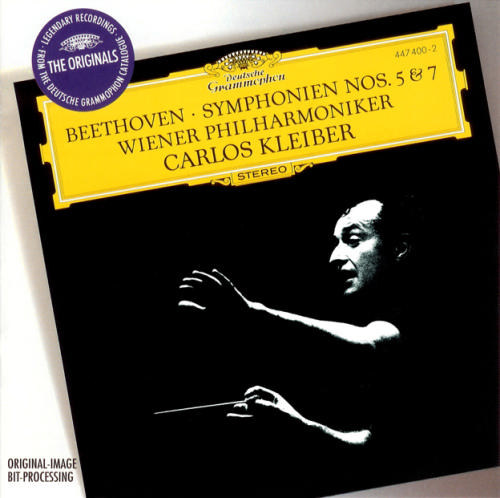
Kleiber conducts Beethoven’s Symphonies Nos. 5 and 7

Artist(s): Kleiber, Carlos

Composer(s): Beethoven, Ludwig van

Series: DG The Originals

My Opinion

This is truly a desert island recording, worthy of inclusion in any respectable top-ten list. If you are a serious connoisseur and classical music lover, your collection would not be complete without it. The recording is actually of such legendary status that I did not think much to decide to start my blog with it, and believe me when I say that my archive has plenty of masterpieces.

Rarely the union between a conductor and an orchestra has been more symbiotic than in these recordings from the 1970s. The Vienna Philharmonic Orchestra is indeed among Europe’s best ensembles and has played the two works with many other distinguished conductors. Yet there is a sense of special opportunity in these two interpretations with Maestro Kleiber, and one has the intimate conviction that virtually all instruments and soloists involved deliver the performance of their lives. And what could be said about Carlos Kleiber’s conducting that has not been said before? incisive and dramatic at moments, charming and delicate at others, it may aptly be qualified as Promethean in his recreation of these two cornerstone works of Western classical music. But the ability of recreation is the essence of being a great conductor, isn’t it?

Other glorious recordings of both symphonies exist of course, and one may naturally think of Wilhelm Furtwängler’s and Otto Klemperer’s sets (both available in EMI’s “Great Recordings of the Century” series) or Herbert von Karajan’s 1960s Beethoven cycle for Deutsche Grammophon. Yet none of these interpretations is a match of Kleiber’s for intensity and dramatic impact. Having said that, please do not take my word for granted and do your homework. If you manage to find a better coupling of Beethoven’s 5th and 7th symphonies somewhere else, please let me know and I will eat my hat!

Reviews

“In a performance of notable urgency, Kleiber gets the Vienna Philharmonic yet again to play the Fifth as if it were a first encounter. The reading is violent, sinuous, shadowy and impassioned, the effect compelling without being overwrought. Kleiber presides over a gripping first movement that goes like a shot, and is to be commended for observing such musicological niceties as the exposition repeats of both the first movement and the finale. The mid-’70s analog recording has received state-of-the art remastering, yielding sound that is vivid and detailed. With a barn-burning account of the Seventh as the coupling, this is a disc to die for.” – Ted Libbey.

“As recommendable an album as anyone could wish, Carlos Kleiber’s performances with the Vienna Philharmonic of Ludwig van Beethoven’s Symphony No. 5 in C minor, Op. 67, and the Symphony No. 7 in A major, Op. 92, are classics that should always be within reach, and this disc should be passed along to friends as the single best pairing of these two pieces. Other performances of these symphonies are absolutely essential to know, and recordings by many great conductors and orchestras certainly compete with this Deutsche Grammophon album for listeners’ affections. But for sheer excitement, cogent direction, and expressive playing, none is more convincing. Kleiber was highly esteemed for his thorough musicianship, and his clarity of interpretation and communication skills with musicians resulted in performances that were compelling in their power and fascinating for their faithfulness to details in the score. If the hallmarks of great performances are the way they grab onto the listener through their energy and sustain interest for their finer points, no matter how familiar the pieces are, then these riveting and utterly lucid readings of Beethoven’s Fifth and Seventh are great indeed. Even purists who insist on period style in their Beethoven must concede honors to Kleiber for his accuracy and attention to repeats, for following the indicated instrumentation, and for careful application of all the dynamics. In depth of musicality, technical polish, and all matters of instrumentation except for the size of the orchestra, these recordings surpass many historically informed performances and make some of them seem pedantic and empty in comparison. Add to these accumulated merits DG’s scrupulous engineering and masterful, incredible ADD sound, and this unassailable disc wins in any match-up.” – Blair Sanderson.

Design a site like this with WordPress.com
Get started