Gieseking plays Debussy’s Preludes, Books I and II
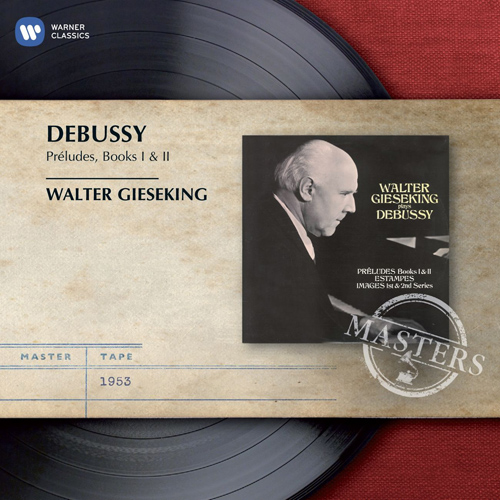
Artist(s): Gieseking, Walter
Composer(s): Debussy, Claude
Series: EMI Great Recordings of the Century
My Opinion
This legendary recording features German master pianist Walter Gieseking, one of the giants of the keyboard in the 20th century, in the popular set of preludes by French composer Claude Debussy.
Gieseking (1895 – 1956) was blessed with unique gifts. It is notorious that he had perfect pitch, and his sightseeing memory was phenomenal – he used to commit entire piano concertos to memory in a couple of days, without even having access to the instrument. No wonder then that he had an immense repertoire, ranging from Bach to the works of the modern composers of the 20th century. It is somewhat striking that this most German of pianists, developed a special affinity and an universally recognized expertise around the French impressionist masters that are Debussy and Ravel. But this is, after all, not that surprising, as their work relies on good control of the tone color and shading, and Gieseking was unmatched in his mastery of the latter.
This is one of the greatest Debussy recordings of all times. Beautiful, intellectually-challenging music interpreted by an old master (he was 57 then) at the height of his powers. In the Debussy Preludes discography, it is the perfect complement to the celebrated recordings by Italian pianist Arturo Benedetti Michelangeli, which I reviewed earlier in this blog. The two sets are great recordings, and there is no point in choosing one of them on top of the other. The pantheon belongs to both, so just cherish the two!
Reviews
“More than 30 years have passed since Gieseking’s death. For a while thereafter his recordings remained as a monument to his art, but these have long been out of circulation. For pianists and listeners of the new generation his is a reputation passed down mainly by admiring older voices and in suspiciously hagiographical literature.
This record should change all that, for it reveals keyboard artistry undimmed by the intervening years. All those critical expostulations over the ravishing quality of sound, the control and shading of pianissimos, the subtlety of pedalling, the ability to individualize and yet blend the strands of a texture, are vindicated. The instrument really does appear to dissolve into something illusory and magical, just as Debussy intended—take ”Le vent dans la plaine”, as one of a dozen possible examples. And if that seems surprising from a 15-stone, six-foot-three German pianist, perhaps even more so are the delightful humour of ”Le danse de Puck” and ”Hommage a S. Pickwick Esq., PPMPC” and the sheer naughtiness of ”Minstrels”.
Two aspects of Gieseking’s art have not stood the test of time quite so well. Reports of his technical perfection sit uneasily alongside his scrambling through the virtuosic preludes, such as ”Les collines d’Anacapri” and ”Ce qu’a vu le vent d’ouest” which suggests that he actually needed to practise rather more than he thought he did (though ”Feux d’artifice” shows the technique in impressive shape). And Gieseking’s much-vaunted fidelity to the text is surely a bit of a fiction. He can be as cavalier over dynamics as the next man—”Ce qu’a vu” works up a good stormy forte long before Debussy cancels the initial piano, for example—and in any case he was clearly working from editions which we now know to be serious misrepresentations.
Far more important though, is the precision of artistic image imparted to each piece—even when Gieseking casts caution and dozens of notes to the winds, this imaginative strength carries him through. And it is worth pondering on the fact that despite the impression of spaciousness this must be one of the fastest Debussy Preludes on record. Background hiss is roughly what one would expect, but if there are any other signs of age in the recording quality Gieseking’s artistry conquers them with ease.” – Review in Gramophone Magazine.

 Jawad's Classical Music Blog