Gilels plays Beethoven’s Piano Concertos Nos. 4 and 5 ‘Emperor’
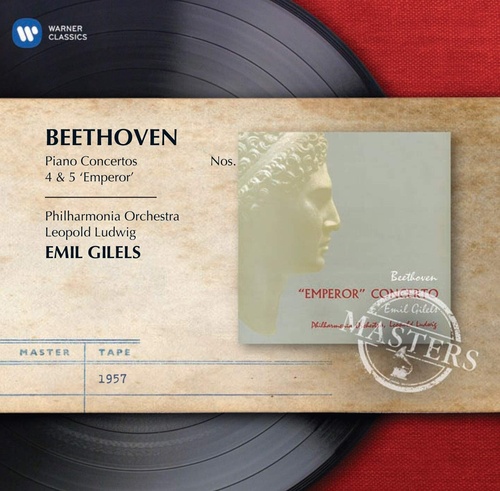
Artist(s): Gilels, Emils
Composer(s): Beethoven, Ludwig van
Series: EMI Great Recordings of the Century
My Opinion
The great Ukrainian pianist Emil Gilels shines in this legendary recording. Made in 1957, it features Beethoven’s last two – and certainly most popular – piano concertos. When he committed this work to shellac, Gilels was already a living legend in the Soviet Union in the 1950s, and one of a few Soviet artists (along with violinist David Oistrakh, and some years later, fellow pianist Sviatoslav Richter) allowed to travel beyond the steel curtain with the (overtly political) purpose of showcasing USSR’s artistry to western audiences. Expectations were – perhaps unreasonably – high, but the lucky ones who discovered Gilels in his first live performances in London, New York, Vienna, or Paris, were certainly awed by the master pianist’s supreme wizardry.
Although the “Emperor” concerto certainly ranks among the best interpretations of the second half of the 20th century, the real highlight of this CD is the fourth piano concerto. Gilels’ reading is full of power, yet supremely poetic and touching in the slow passages. The second movement, a case in point, has never sounded as magical – and will it ever be? Leopold Ludwig conducts a virtuoso-filled Philharmonia Orchestra and provides elegant and sympathetic accompaniment. The transfer sound is more than adequate for the period.
Allow me to put it plain and simple: there is no better Beethoven fourth piano concerto on record. Period. It would be foolish not to get this CD, listen to it whenever the mood is down, and cherish it for the rest of your – hopefully long and prosperous – life.
Reviews
“Classic accounts of Beethoven here, as Bryce Morrison’s overtly laudatory booklet note makes clear. There are many other Gilels versions of both concertos, but none can boast the resplendent orchestral playing that the Philharmonia delivers nor the excellent – if somewhat beefy – sound provided by Walter Legge and Robert Gooch.
Gilels’ discography lists a number of other Fourths: Leningrad with Sanderling (1957); Czech PO also with Sanderling (1958); live from Naples with Pradella (1965); the famous Cleveland cycle of 1968; USSRSO under Masur (1976) and a live Bavarian performance with Sawallisch (1979). Personally I am most familiar with the Szell Cleveland cycle – with which I was brought up. There is significantly more humanity in these readings of over a decade earlier.
The opening of the present Fourth is very serene and unhurried. Originally issued on Columbia 33CX 1055, this is a magnificent performance. The Fourth is in some ways the trickiest, finger-wise, of the Beethovens. Not that anyone would guess it from Gilels’ finger strength at around 9:20 in the first movement. Only some muddying in the orchestral textures detracts – as I say, the orchestral recording can be a bit obscured at times.
Curiously the orchestra sounds rather dry at the opening of the second movement, something one forgets immediately at Gilels’ hyper-placatory entrance. The end of Orpheus and the Beasts is magical; the finale is full of drive; the strings are nicely together at the opening. If the cadenza is perhaps a touch heavy to begin with, it is small cause for complaint. This is memorable music-making.
There are apparently eleven Gilels ‘Emperors’. Of these I would love to hear the live Chicago with Martinon of 1966. With Ludwig, Gilels seems astonishingly at home, able to unleash the largest fortissimi: the chords around 10’30 in the first movement. His sovereign command is never in doubt here, as he shines from first note to last. Fingerwork is crystal throughout.
Ludwig, excellent in No. 4, if anything excels himself in the ‘Emperor’. The very opening E flat chord is absolutely resplendent, while the opening of the Adagio un poco mosso is unutterably tender, the perfect preparation for Gilels’ magic touch. Nice to hear the accompanying woodwind chords around 3’30, just a pity the oboes are not together at 3’34 – a small point perhaps, but once you’ve heard it you start expecting it on rehearings.
The finale is big-boned, a testament, perhaps, to the barn-storming, revolutionary image of Beethoven, with Gilels’ iron fingers again making Beethoven’s demands seem laughably easy. I should report a pressing error on my copy just before the very end (8’26).
These performances demand to be heard.” – Colin Clarke.
“Although Testament’s 1997 transfers of these 1957 Beethoven recordings markedly improved upon their best-sounding LP incarnations, EMI’s newer Great Recordings of the Century remasterings boast greater amplitude and richness of detail, all to Emil Gilels’ benefit. In several respects I prefer these recordings to Gilels’ remakes with George Szell and the Cleveland Orchestra. The pianist’s spacious conception of the Fourth Concerto cuts Beethoven’s rippling passagework and long trills plenty of poetic slack, and he doesn’t beat the first movement’s left-hand szforzandos over your head as he did under Szell.
Like Gieseking, Gilels’ symmetrical phrase shaping sidesteps the angular accentuation and harmonic tension Leon Fleisher brings out, and he favors Beethoven’s alternate, slightly jarring first-movement cadenza. Still, this remains an impressive performance, and the Philharmonia Orchestra’s first-desk woodwind soloists deserve special mention.
The Emperor Concerto’s outer movements contain a few ensemble lapses and wrong notes, while Gilels presses ahead in passages that would considerably gain from greater inflection and flexibility (the first movement’s B major episode, for instance). But the slow movement is worth this CD’s price. Leopold Ludwig’s basic tempo is unusually slow, yet it’s gorgeously sustained and never drags. Gilels’ hushed entrance is one of the miracles of recorded sound: it appears like an apparition, with every note an exquisite pearl to savor, and not a hint of self-awareness. Pure genius.” – Jed Distler, Review for ClassicsToday.com.

 Jawad's Classical Music Blog