Böhm conducts Mozart’s Così Fan Tutte
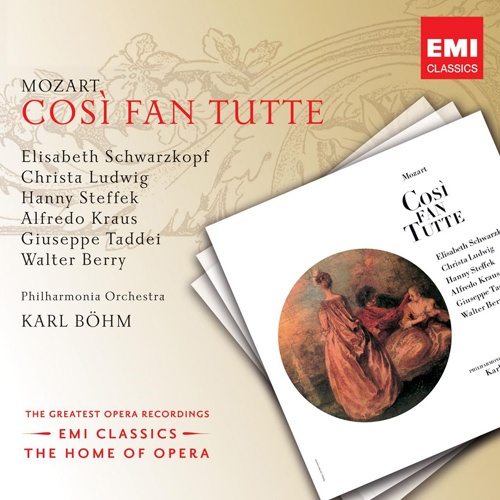
Artist(s): Böhm, Karl
Schwarzkopf, Elisabeth
Ludwig, Christa
Kraus, Alfredo
Taddei, Giuseppe
Berry, Walter
Composer(s): Mozart, Wolfgang Amadeus
Series: EMI Great Recordings of the Century
My Opinion
Mozart finished the composition of Così Fan Tutte in 1780. The work is not the composer’s most well-known opera to the general public, but still has its unique charm and distinctive cachet. Modern musicologists are adamant that Così is the work of a composer at the pinnacle of his considerable creative powers. Suffice to say that the opera was created during the miraculous last two years of the Austrian genius’ life, along with such absolute masterpieces as The Magic Flute, the last piano concerto (No. 27), and the Requiem! Such exuberance of absolute masterpieces in such a short period of time is unmatched in the history of music, and can be seen as one of God’s miracles and most precious gifts to mankind.
In my opinion, two recordings stand out and are head and shoulders above a crowded – albeit of uneven quality – Così discography: The present recording, and Herbert von Karajan’s 1954 earlier collaboration with EMI, featuring a dream cast made of such distinguished singers as Dame Elisabeth Schwarzkopf, the incomparable Leopold Simoneau, Lisa Otta, Nan Merriman, and Sesto Bruscantini. While Karajan’s peerless singing cast cannot be surpassed, Böhm’s reading takes advantage of the Austrian master’s intimate understanding of Mozart, as well as of the overall better sonic quality of the CD transfer – Böhm’s is recorded in stereo, while Karajan’s is in mono. But you do not really need to choose, do you? Just rush and get both recordings. Your ears and your taste will be most grateful.
Reviews
“In essence, EMI’s 20-bit remastering of Karl Böhm’s 1962 Così fan tutte fortifies the lower strings, winds, and timpani, while sharpening note attacks and word endings. By contrast, the label’s 1988 CD transfer is equalized more evenly from top to bottom. The close-up, slightly dry sonics underline Böhm’s tightly-knit, forthright, and sober conception. He opens many of the recitative cuts made in Karajan’s earlier Philharmonia Così, while presiding over a strong cast. Elisabeth Schwarzkopf’s silvery Fiordiligi didn’t age at all since the Karajan recording, but here she enacts the text to a more precious degree. Christa Ludwig’s darker voice and more direct musicianship, though, make a desert island Dorabella. As Ferrando, Alfredo Kraus’ hefty, ringing tenor will appeal to tastes other than mine (I greatly prefer Karajan’s Leopold Simoneau, one of the most elegant stylists to undertake this part). But how Giuseppi Taddei wraps his beguiling, idiomatic, and alert pipes around Guglielmo’s music! The unusual clarity and precision of the chorus merits special distinction too. All in all, Böhm’s Così, among traditional (that is, non-period instrument) recordings, safely holds its long-time benchmark position. Excellent, frank notes, plus full texts and translations are included.” – Jed Distler.
“This was the first complete Mozart opera I ever bought and it was through this version that I learned to love it. Böhm’s earlier studio recording in excellent stereo is commendable, especially for Lisa Della Casa’s Fiordiligi and of course Christa Ludwig’s first Dorabella, but some of the Italian, apart from Della Casa’s, obviously, is a bit Germanic and I don’t think the men are as elegant; this 1962 recording, however, was blessed and for many remains unsurpassed. Oddly enough, I don’t especially like either Elisabeth Schwarzkopf or Alfredo Kraus in other repertoire, but here her patrician archness and pellucid technique are perfect for depicting the prim Fiordiligi and his slightly reedy, delicate tones are just right for suggesting Ferrando’s starchy smugness before the teenage Angst of his rude awakening. Ludwig is of course delightful: warm and passionate of voice. Taddei sounds a bit old but is a sharp, biting, vocally acute Guglielmo and Berry’s knowing, cynical humorousness as Don Alfonso is ideal. Hanny Steffek makes a pert, funny Despina. Furthermore, all their voices combine ideally, so ensembles are a joy, especially the famous “Soave sia il vento” and the exquisite Brindisi quartet. Böhm’s pacing is just so for extracting the comedy and the orchestra’s playing is impeccably stylish. OK; there are one or two ugly tape joins – notably thirty seconds into “Fra gli amplessi” – but otherwise the early stereo sound is beautifully clear and balanced. The cuts are the standard Nos. 7 and 24 plus a small one in the Act 1 finale. If you love this opera as I do you will want this version in your collection.” – Ralph Moore.

 Jawad's Classical Music Blog